
Hello Friends
I’m excited to share my very first newsletter with you! This marks a pivotal moment in how I engage with my audience through both my website and YouTube channel. The newsletter will serve as a space to share ideas, stories, and features I’m planning to introduce on my channel. While the content on YouTube will often overlap with the newsletter, it’ll be presented in a different format to suit the platform. And since writing isn’t my strong suit, I’ve enlisted Stacy, my trusty AI, to help me organize my thoughts.
Exploring New Stories and Technical Narratives
I’ve been thinking about diving deeper into technical storytelling on my YouTube channel. I want to explore topics that bring together my passion for technology and history while sharing insights with you, my viewers.
One of the key themes I want to highlight is the stark difference between communication today and back in the 1960s. Back then, there was no internet, social media, or chat channels. Communication was limited to TV, radio, and the expensive telephone network. Long-distance calls were rare and often reserved for special occasions like Christmas. Yet there was one form of “social media” back then: Ham Radio.
My Journey with Ham Radio
In the early 1960s, I discovered Ham Radio as a way to explore technical skills and connect with others. It became my social media of the time, allowing me to form groups of friends and talk with people across distances. Of course, getting a Ham Radio license required studying FCC rules, which were restrictive in terms of what could be discussed.
I also stumbled upon quirks in the telephone system, which piqued my curiosity. For instance, I noticed people could talk between the beeps of a busy signal! It was small moments like these that shaped my early fascination with communication technology.
My first steps in broadcasting
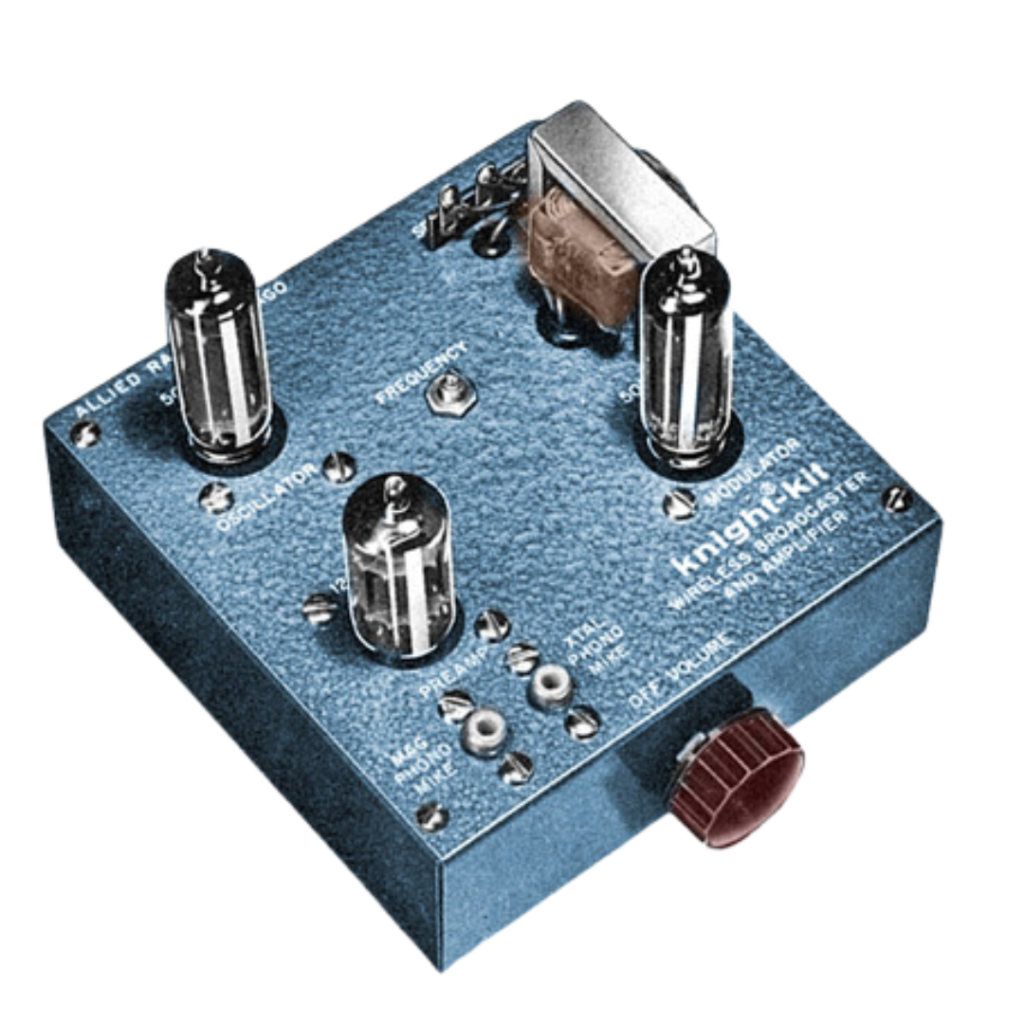
Knight Kit Wireless Broadcaster
In 1961, while living on Travis Air Force Base, I found this at a thrift shop. It was a pre-assembled transmitter, and I begged my mom to buy it for me for $6. Using an old RCA record player and a handful of 45 RPM records, I set up my first “radio station.”
With a 25-foot antenna wire hanging out my window, I started broadcasting. The signal was modest, only reaching a few blocks, but it was enough to fuel my curiosity. I quickly realized I needed more power. At the time, I didn’t know much about electronics, but I was determined to learn.
Experimenting with Power Amplifiers
After moving to Sacramento in 1962, I attended Encina High School and took a basic electronics class. I also picked up a copy of the Ham Radio Handbook and learned to calculate component values for building a small 1-tube RF amplifier. My experiments involved scavenging parts from surplus stores, such as a 6L6 tube, a power transformer, and filter capacitors, which I mounted on a pie pan—a cheap and effective base for my projects.
One memorable challenge was building an AM modulator to amplify my signal properly. With guidance from a Ham buddy, I used two audio transformers connected back-to-back, which worked surprisingly well.
Looking Back and Moving Forward
These early experiments in electronics and broadcasting shaped my lifelong passion for technology. While my methods might seem primitive by today’s standards, they were stepping stones for a self-taught journey that continues to this day.
I hope my younger readers find these stories inspiring, and for the old-timers, I hope they bring back fond memories of tinkering with antique technology. I’d love to hear your thoughts, comments, and even critiques about this trip down memory lane. For my readers who share my passion for electronics, let me know where I can find some 6L6 tubes—I’d like to recreate these circuits using modern tools like LTSpice or KiCad.
join the conversation
I’d like to think of myself as a tech historian of sorts, documenting and sharing my personal experiences as technology evolves. Whether you’re an old-school enthusiast or a curious newcomer, your feedback means a lot to me. Let’s explore these technologies together and keep the spirit of innovation alive.
Thank you for reading my first newsletter! If you’d like to stay updated, please subscribe, comment, and share your ideas. I’m looking forward to building this community with all of you.
Warm regards,
John Draper (The Crunch Man)
“Exploring the past to shape the future”
Please feel free to comment, and also please tell me where I can get 6L6’s because I want to emulate the circuit using a modern circuit analysis program like LTSpice, or KiCad, where I hope to “emulate” the transmitter, perhaps with the help of my old school readers and viewers
COMMENTS ENABLED!